
AI Search
AI Search: A Practical Guide to the New Era of Search
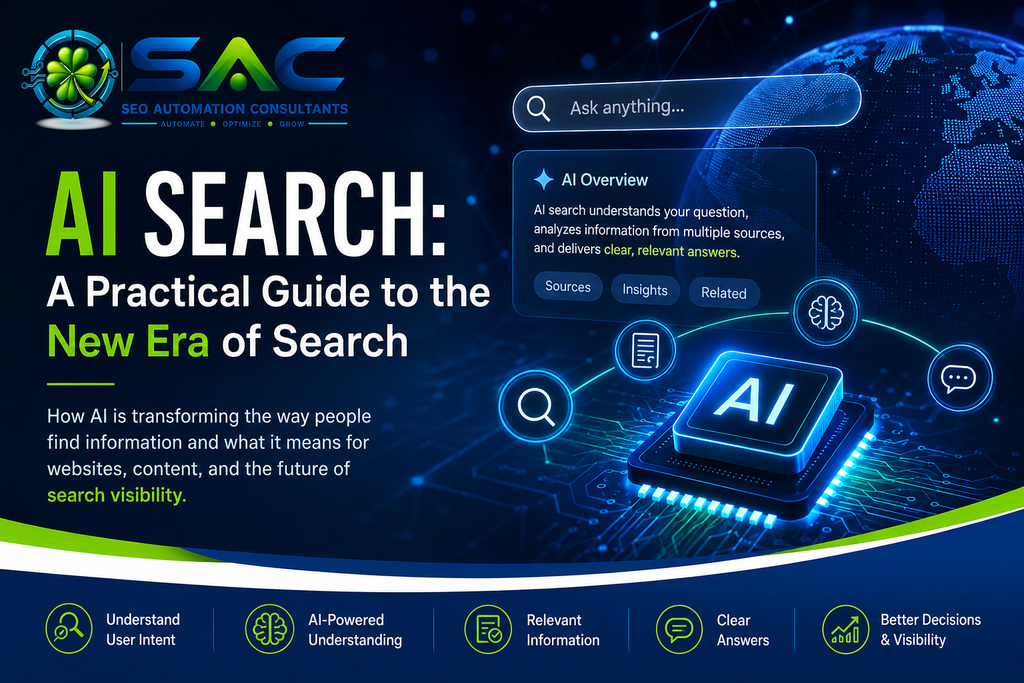
Search is changing.
For many years, finding information online usually meant entering a few words into a search engine and browsing through a list of web pages. Today, artificial intelligence is changing that experience.
AI-powered search systems can understand questions expressed in natural language, interpret context, connect information from different sources, and provide answers in a more conversational format.
This change does not mean traditional search has disappeared. Instead, the way people discover, evaluate, and interact with information is expanding.
Understanding AI Search is therefore becoming an important part of understanding the future of search visibility.
What Is AI Search?
AI Search refers to search experiences that use artificial intelligence to understand a user’s query and provide more meaningful results or answers.
Traditional search generally matches a query with relevant web pages.
AI-powered systems can go further by attempting to understand:
- What the user is asking
- The context behind the question
- The user’s likely intent
- Relationships between different pieces of information
- Which information is relevant to the question
- How the answer should be presented
Instead of requiring users to visit several pages and combine the information themselves, an AI search experience may provide a summarized or conversational response.
How Is AI Search Different From Traditional Search?
Traditional search is primarily built around retrieving and ranking web documents.
AI Search introduces an additional layer of interpretation and generation.
A simplified comparison looks like this:
Traditional Search
Query → Retrieve → Rank → Display Results
AI Search
Question → Understand Intent → Retrieve Information → Interpret Context → Generate Response
The distinction is important because users are increasingly asking longer, more conversational questions rather than relying only on short keyword searches.
How AI Search Works
AI Search can involve several technologies working together.
1. Understanding the Query
The system first attempts to understand what the user actually wants.
For example, the question:
“What should I check before buying a laptop for video editing?”
contains considerably more intent than simply searching for:
“video editing laptop.”
Understanding the difference helps an AI system provide a more useful response.
2. Finding Relevant Information
The system may identify information from available sources, databases, search indexes, websites, or other knowledge sources depending on the particular AI search system.
The objective is to find information that is relevant to the question.
3. Understanding Context
AI systems can use relationships between concepts to interpret information.
This can help connect related topics rather than treating every word in a query as an isolated keyword.
4. Generating an Answer
The system can then generate a response based on the information and context it has processed.
The result may be a direct answer, summary, comparison, explanation, list, or conversational response.
5. Providing Supporting Information
Some AI search experiences can also provide links, citations, sources, or references that allow users to investigate the information further.
This creates a bridge between traditional web discovery and AI-generated answers.
Why AI Search Matters
AI Search can change the way people discover information.
Instead of asking:
“Which webpage should I open?”
a user may increasingly ask:
“Give me the answer and explain why.”
This can make search more conversational and efficient.
It can also change how websites receive visibility because being present in an AI-generated answer can be different from appearing as one of many traditional search results.
AI Search and Search Intent
Search intent becomes even more important in an AI-driven environment.
A query can have several possible intentions.
For example:
“best camera for travel”
could mean:
- Which camera should I buy?
- What features matter for travel?
- Which cameras are lightweight?
- Which camera has the best battery life?
- What is the best option within a specific budget?
Understanding the underlying question is more useful than simply matching the words in the query.
This is why useful content should address the actual information need, not just the keyword.
What Is AEO?
AEO, or Answer Engine Optimization, refers to the practice of organizing and presenting information so that answer-focused systems can understand it more easily.
AEO commonly emphasizes:
- Clear questions and answers
- Well-structured information
- Direct explanations
- Relevant entities
- Concise factual statements
- Logical content organization
- Strong topical relevance
AEO is closely connected to SEO, but the emphasis is often on becoming a useful source for direct answers rather than focusing exclusively on traditional rankings.
What Is GEO?
GEO, or Generative Engine Optimization, is a term used to describe optimization for generative AI search experiences.
The field is relatively new and continues to evolve.
The underlying principles include making information:
- Clear
- Relevant
- Trustworthy
- Well structured
- Easy to interpret
- Supported by useful context
There is no universal formula that guarantees inclusion in an AI-generated answer.
Different AI systems use different technologies, sources, models, and retrieval processes.
Does AI Search Replace SEO?
No.
Traditional SEO remains an important part of search visibility.
A technically accessible website, useful content, strong information architecture, relevant internal links, structured data, and clear topical relevance can benefit both traditional search and emerging AI-driven search experiences.
AI Search should therefore be viewed as an evolution of search, rather than a complete replacement for SEO.
The Importance of Clear and Useful Content
AI systems need information that can be understood.
Content that is unnecessarily complicated, repetitive, vague, or poorly structured can be difficult for both users and machines to interpret.
Useful content generally benefits from:
- Clear headings
- Logical sections
- Direct explanations
- Accurate information
- Relevant examples
- Natural language
- Proper context
- Supporting evidence where appropriate
Writing for AI does not mean writing for machines instead of people.
The best approach is to create information that is genuinely useful to people and easy for systems to understand.
Structured Data and AI Search
Structured data provides machine-readable information about a webpage.
It can help describe entities and content types such as:
- Organizations
- Products
- Articles
- Events
- Businesses
- Breadcrumbs
- Reviews
Structured data does not guarantee AI visibility.
However, clearly defined information can help search systems better understand what a page represents and how different pieces of information relate to one another.
Entity Understanding
AI-powered search relies heavily on understanding entities and relationships.
An entity can be a:
- Person
- Organization
- Place
- Product
- Concept
- Brand
- Event
For example, a page about a particular technology should clearly explain what that technology is, how it relates to other technologies, where it is used, and why it matters.
This creates context that is much richer than simply repeating a keyword.
Topical Authority
A website covering a subject thoroughly can provide stronger contextual signals than a website publishing disconnected articles about unrelated topics.
Topical coverage can involve:
Main Topic → Subtopics → Supporting Questions → Related Concepts → Internal Links
For example, a website discussing AI Search might naturally cover:
- AI Search
- Generative Search
- AEO
- GEO
- Search Intent
- Large Language Models
- Retrieval-Augmented Generation
- Structured Data
- Semantic Search
- Traditional SEO
The objective is not to publish content for the sake of quantity.
It is to create a useful body of knowledge around a subject.
AI Search and Website Visibility
Website visibility may increasingly involve more than traditional ranking positions.
A website can potentially be discovered through:
- Traditional organic results
- Featured search features
- AI-generated answers
- Conversational search
- Knowledge panels
- Voice-based search
- Other emerging discovery interfaces
This means search visibility is becoming a broader concept.
The important question is no longer only:
“Where does this page rank?”
It can also be:
“How is this information being discovered and represented across different search experiences?”
What Websites Should Focus On
There is no single optimization trick that guarantees visibility in AI Search.
Instead, websites should focus on strong fundamentals.
These include:
- Technically accessible pages
- Helpful and original content
- Clear information architecture
- Accurate information
- Strong topical relevance
- Logical internal linking
- Structured data where appropriate
- Clear entity information
- Good user experience
- Demonstrable expertise and trustworthiness
These principles are valuable regardless of which search technology a user chooses.
The Future of Search
Search is moving from simple keyword retrieval toward increasingly conversational and context-aware experiences.
People may search using complete questions, follow-up questions, comparisons, and detailed scenarios.
AI can make this process more natural by helping users move from a question to an answer without manually opening and comparing many pages.
At the same time, trustworthy and useful websites remain important because AI systems need reliable information to understand and answer questions.
The future of search is therefore likely to involve a combination of:
Search Engines + AI + Websites + Structured Information + Human Expertise
The Bigger Picture
AI Search is not simply another SEO trend.
It represents a broader change in how information can be discovered, interpreted, summarized, and presented.
Traditional SEO provides the foundation.
AEO focuses on answers.
GEO explores visibility within generative experiences.
Structured data provides machine-readable context.
High-quality content provides the underlying information.
Together, these areas form an evolving search ecosystem where the ability to communicate information clearly is becoming increasingly important.
The fundamental principle remains simple:
Create useful information for people, structure it clearly, and make it understandable to machines.
Frequently Asked Questions About AI Search
What is AI Search?
AI Search refers to search experiences that use artificial intelligence to understand queries, process information, and provide more direct or conversational answers.
How is AI Search different from traditional search?
Traditional search generally presents a list of relevant web pages for a query. AI Search can interpret a conversational question and generate a synthesized response based on information available to the system.
What is AI Search Optimization?
AI Search Optimization is the practice of making website information easier for AI-powered search systems to understand, interpret, and potentially reference.
What is AEO?
AEO, or Answer Engine Optimization, focuses on organizing information so that answer-focused systems can more easily identify and provide useful responses to questions.
What is GEO?
GEO, or Generative Engine Optimization, is a term used to describe efforts aimed at improving the visibility and representation of information within generative AI search experiences.
Does AI Search replace SEO?
No. Traditional SEO remains important. Technical accessibility, useful content, search intent, internal linking, structured information, and website quality continue to matter.
How can a website become more visible in AI Search?
There is no guaranteed formula for appearing in AI-generated answers. Websites can improve their overall discoverability by providing clear, useful, trustworthy, well-structured information and maintaining a technically accessible website.
Does structured data help with AI Search?
Structured data can help search systems understand specific information on a webpage. It does not guarantee AI visibility, but accurate structured data can contribute to better machine understanding of eligible content.
Should content be written differently for AI Search?
Content should not be written only for machines. The strongest approach is to create information that is clear, accurate, useful, well organized, and genuinely helpful to people.
Is AI Search the future of SEO?
AI is becoming an increasingly important part of search, but SEO is unlikely to disappear. Search technology continues to evolve, and SEO, AEO, GEO, structured data, content strategy, and technical optimization are becoming increasingly connected.