SEO
Search Engine Optimization (SEO): A Practical Guide to Better Search Visibility
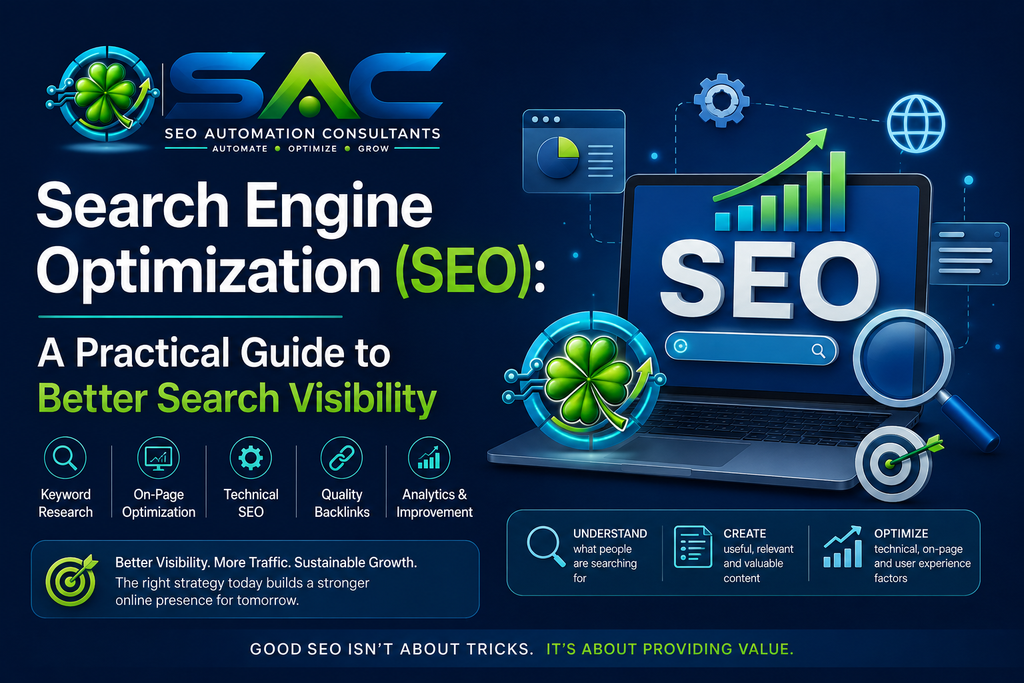
Search Engine Optimization, commonly known as SEO, is the process of improving a website so that search engines can better understand its content and users can find useful information through organic search.
SEO is often reduced to keywords and rankings, but modern SEO is much broader. It involves the technical structure of a website, content quality, search intent, internal linking, page experience, authority, structured data, and how clearly a website communicates its subject matter to search engines and users.
A successful SEO strategy does not begin with trying to manipulate rankings. It begins with understanding what people are searching for, what information they need, and how a website can provide the most useful answer.
What Is SEO?
When someone searches for a topic on a search engine, the search engine has to determine which pages are most relevant and useful for that query.
SEO helps a website make that information easier to discover and understand.
This can involve improving:
- Website structure
- Page content
- Search intent alignment
- Technical accessibility
- Internal links
- Page speed
- Mobile usability
- Structured data
- Content organization
- Website authority
- Overall user experience
The purpose is not simply to attract more visitors. The objective is to attract relevant visitors who are looking for the information, product, service, or solution that a website provides.
How Search Engines Understand Websites
Search engines use automated systems to discover, crawl, render, index, and evaluate web pages.
A simplified SEO process looks like this:
Discovery → Crawling → Rendering → Indexing → Ranking → Search Results
If search engines cannot properly access or understand important pages, even high-quality content may struggle to achieve visibility.
This is why SEO needs to consider both the technical foundation and the content published on the website.
The Main Areas of SEO
SEO can be divided into several connected areas.
Technical SEO
Technical SEO focuses on the technical foundation of a website.
It includes areas such as:
- Crawling and indexation
- XML sitemaps
- Robots.txt
- Canonical URLs
- Redirects
- URL structures
- Internal linking
- JavaScript rendering
- Mobile usability
- Page speed
- Core Web Vitals
- Structured data
- Duplicate content
Technical SEO does not replace good content. Instead, it helps create the conditions in which useful content can be properly discovered and understood.
On-Page SEO
On-page SEO focuses on the information and structure of individual pages.
Important elements include:
- Page titles
- Headings
- Main content
- Images and alt text
- Internal links
- Meta descriptions
- Structured data
- Content organization
- Search intent
Good on-page SEO makes it easier for both users and search engines to understand what a page is about.
Content SEO
Content plays an important role in organic search.
However, publishing more content does not automatically mean better SEO.
Useful content should address a genuine search need and provide information that is clear, accurate, relevant, and sufficiently useful for the topic.
A good content strategy considers:
Topic → Search Intent → Audience → Information Need → Content Format → Internal Linking
Content should be created because it provides value, not simply because another keyword has been identified.
Off-Page SEO
Off-page SEO refers to signals and activities that occur outside the website itself.
One well-known example is backlinks.
Links from other relevant and trustworthy websites can help search engines understand the authority and relevance of a website.
However, acquiring links purely for quantity can create problems. Relevance, context, editorial value, and overall website quality are more important than simply collecting large numbers of links.
Local SEO
Local SEO helps businesses become more visible when people search for information related to a specific location.
Local search can involve:
- Google Business Profile
- Local landing pages
- Business information
- Reviews
- Local content
- Location-based keywords
- Local structured data
- Citations
- Local search relevance
For businesses serving a particular geographic area, local visibility can be an important part of organic search strategy.
Keywords Are Important — But Search Intent Matters More
Keywords remain useful because they provide insight into what people search for.
But simply repeating a keyword throughout a page is not effective SEO.
A page should first understand the search intent behind the query.
For example, someone searching for:
“what is technical SEO”
is probably looking for an explanation.
Someone searching for:
“technical SEO audit checklist”
may be looking for a practical resource.
Someone searching for:
“technical SEO consultant”
may have a commercial or transactional intent.
The content should reflect that difference.
Internal Linking
Internal links connect pages within the same website.
A well-planned internal linking structure can help:
- Users discover related information
- Search engines discover pages
- Search engines understand relationships between topics
- Important pages receive appropriate internal authority
- Content clusters become easier to understand
Internal linking should be useful and contextual rather than added simply to increase the number of links on a page.
SEO and User Experience
Search visibility and user experience are closely connected.
A page may attract a visitor through search, but if the page is difficult to use, slow to load, confusing, or does not answer the visitor’s question, the traffic may have limited value.
Important considerations include:
- Mobile usability
- Page speed
- Readability
- Navigation
- Content structure
- Accessibility
- Intrusive elements
- Clear information
SEO should ultimately help people find and consume useful information more easily.
Structured Data and Schema Markup
Structured data provides additional information about the content of a page in a machine-readable format.
Depending on the content, structured data can describe things such as:
- Articles
- Products
- Organizations
- Businesses
- Events
- FAQs
- Breadcrumbs
- Reviews
Schema markup does not guarantee higher rankings, but it can help search engines better understand certain types of content and, where supported, make pages eligible for enhanced search features.
SEO Analytics
SEO should be measured rather than judged only by impressions or individual keyword positions.
Useful metrics can include:
- Organic clicks
- Search impressions
- Click-through rate
- Indexed pages
- Search queries
- Organic landing pages
- Conversions
- Engagement
- Technical errors
- Ranking trends
Google Search Console and Google Analytics can provide different perspectives on organic search performance.
The most useful analysis connects search visibility with actual website outcomes.
SEO and AI Search
Search is changing as AI-powered systems become part of how people discover information.
Users may now ask conversational questions and expect direct answers rather than browsing several traditional search results.
This has created growing interest in areas such as:
- AEO — Answer Engine Optimization
- GEO — Generative Engine Optimization
- AI Search Optimization
The fundamentals remain familiar: clear information, useful content, strong topical relevance, trustworthy sources, structured information, and a technically accessible website.
AI search does not make traditional SEO irrelevant. Instead, it expands the number of ways information can be discovered.
Common SEO Mistakes
Some common SEO problems include:
- Creating content only for keywords
- Publishing very similar pages
- Ignoring technical issues
- Overusing keywords
- Neglecting internal links
- Creating pages without a clear search intent
- Focusing only on rankings
- Ignoring mobile users
- Building low-quality backlinks
- Publishing AI-generated content without meaningful review
- Removing useful content simply because it has low traffic
- Treating SEO as a one-time activity
SEO generally works better when improvements are based on evidence, testing, and continuous analysis.
SEO Is an Ongoing Process
Search engines evolve, websites change, competitors publish new content, and user behavior shifts over time.
Because of this, SEO is not something that can simply be completed once and forgotten.
A healthy SEO process usually involves:
Research → Audit → Strategy → Implementation → Measurement → Improvement
The emphasis should remain on creating a website that is accessible, useful, understandable, trustworthy, and relevant to its audience.
The Bigger Picture
SEO is ultimately about connecting people with information that genuinely helps them.
Technical optimization makes information accessible.
Content provides the answers.
Internal linking connects related knowledge.
Structured data helps machines understand information.
Analytics shows what is working.
And emerging AI search technologies are creating new ways for people to discover that information.
Understanding these elements together provides a much stronger foundation than treating SEO as a collection of keywords and ranking tricks.
Frequently Asked Questions About SEO
What is SEO in simple terms?
SEO, or Search Engine Optimization, is the practice of improving a website so that search engines can understand its pages and users can discover relevant information through organic search results.
Why is SEO important for a website?
SEO can help a website become more discoverable when people search for relevant topics, products, or information. It can also improve website structure, content organization, usability, and overall search visibility.
How long does SEO take to show results?
There is no fixed timeframe for SEO results. The timeline can depend on factors such as website history, competition, technical condition, content quality, industry, search demand, and the type of improvements being implemented.
Is SEO only about keywords?
No. Keywords are only one part of SEO. Modern SEO also involves technical accessibility, search intent, content quality, internal linking, website architecture, structured data, user experience, authority, and measurement.
What is technical SEO?
Technical SEO focuses on the technical aspects of a website that affect how search engines crawl, render, understand, and index its pages. It can include areas such as site architecture, redirects, XML sitemaps, canonical URLs, mobile usability, page performance, and structured data.
What is the difference between SEO and paid search?
SEO focuses primarily on earning visibility through organic search results. Paid search uses advertising platforms to place advertisements in search results. Both can support online visibility, but they work through different mechanisms.
Does publishing more content improve SEO?
Not necessarily. Publishing large amounts of content does not automatically improve search visibility. Useful content should address genuine search needs, demonstrate relevance, and provide meaningful information to the intended audience.
What is AI Search Optimization?
AI Search Optimization refers to improving the clarity, structure, relevance, and accessibility of website information so that AI-powered search systems can better understand and potentially use that information when generating answers.
What are AEO and GEO?
AEO, or Answer Engine Optimization, focuses on making information suitable for systems that provide direct answers to questions.
GEO, or Generative Engine Optimization, focuses on visibility and representation within generative AI search experiences.
Both are emerging areas connected to the broader evolution of search.
Is SEO a one-time process?
No. SEO is generally an ongoing process because search engines, competitors, websites, content, technologies, and user behavior continue to change. Regular monitoring and improvement help maintain and develop search visibility over time.